

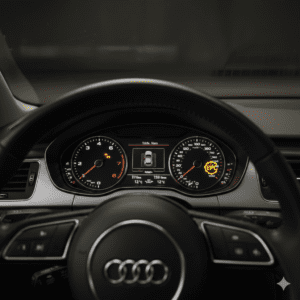
If your Audi is losing coolant in Dubai, do not ignore it. A coolant leak can start as a small drop in the reservoir level, a sweet smell from the engine bay, or a warning on the dashboard. But if the leak gets worse, your Audi can overheat quickly in Dubai traffic and heat, which can lead to expensive engine damage.
At WagenKenner, we inspect Audi coolant leaks regularly on models such as the A3, A4, A5, A6, Q3, Q5, Q7 and other Audi vehicles in Dubai. If you are dealing with repeated warning lights, overheating, coolant loss or other model-specific faults, you can also explore our Audi problems in Dubai guide. In many cases, the leak is not from the radiator itself. It may come from the water pump, thermostat housing, expansion tank, coolant hose, radiator side tank, or another part of the cooling system.
Quick Answer: What causes an Audi coolant leak in Dubai?
An Audi coolant leak in Dubai is commonly caused by a failing water pump, cracked thermostat housing, leaking radiator, damaged coolant hose, worn expansion tank, or loose hose connection. If your Audi is losing coolant, showing a low coolant warning, or overheating in traffic, it should be checked as soon as possible to prevent further engine damage.
What are the signs of a coolant leak in an Audi?
A coolant leak does not always begin with heavy overheating. In many cases, the early signs are small and easy to miss. The most common warning signs include:
Coolant level dropping repeatedly
Low coolant warning on the dashboard
Sweet coolant smell from the engine bay
Pink, purple, red, or orange fluid under the car depending on coolant type
Steam from the bonnet after driving
Engine temperature rising higher than normal
Heater performance becoming weak or inconsistent
Visible coolant residue around hoses, radiator, water pump, or coolant tank
Some owners top up the coolant and continue driving. That is risky. If the coolant level keeps dropping, there is usually a leak somewhere in the system, and the problem will not fix itself.
Why do Audi coolant leaks become serious so quickly in Dubai?
Dubai conditions make cooling-system problems more dangerous. Long idling, heavy traffic, high ambient temperatures, and extra cooling demand all put more pressure on the system. A small leak that seems manageable on a cool day can become a bigger problem when the car is stuck in traffic with the air conditioning running. If your temperature starts climbing in slow traffic, our guide on Audi overheating in traffic explains why this happens and why it should not be ignored.
If the coolant level drops too far, the engine may start overheating. On many Audi engines, overheating can lead to warped components, damaged seals, or major repair bills if the issue is ignored for too long.
Common causes of Audi coolant leaks
There is no single reason why every Audi starts leaking coolant. The source depends on the model, engine layout, mileage, and the condition of the cooling system. These are the most common causes we check.
1) Water pump leak
The water pump is one of the most common causes of coolant loss in an Audi. If the pump seal begins to fail or the pump housing develops a leak, coolant can escape slowly at first and then worsen over time.
Typical signs of a water pump coolant leak include:
Coolant level dropping without an obvious puddle
Dried coolant marks near the pump area
Coolant smell after driving
Engine temperature becoming unstable
Some Audi owners only notice the problem after a low coolant warning appears more than once.
If testing identifies leakage from the pump or an integrated thermostat housing, our Audi water pump and thermostat replacement in Dubai guide explains how the fault is confirmed, when replacement is justified, and which factors affect the repair.
2) Thermostat housing leak
On many Audi engines, the thermostat housing is another common failure point. Over time, the housing or seal can crack, warp, or start leaking. When that happens, coolant may drip down the engine and be difficult to spot without a proper inspection.
A thermostat housing leak can sometimes be confused with a water pump leak because both can leave coolant residue around the front or side of the engine.
3) Radiator leak
Radiators can leak from the core, side tanks, drain area, or hose connection points. In Dubai, heat and age can accelerate wear on plastic components and seals. If the radiator is leaking, you may notice coolant under the front of the car, residue around the radiator area, or rising temperature during traffic.
A radiator leak should not be ignored. Once the leak opens up further, the coolant loss can become much faster.
4) Coolant hose or connector leak
Audi coolant hoses and connectors can weaken over time. Rubber hoses can age, seals can harden, and plastic connectors can crack. A small split in a hose or a weak connection may only leak under pressure, which is why some coolant leaks are difficult to catch without testing the system properly.
This type of leak often becomes more obvious after the engine warms up and the cooling system builds pressure.
5) Expansion tank or coolant reservoir leak
The coolant expansion tank can crack with age or develop leaks around the cap, seams, or sensor area. If the tank is damaged, the coolant level may keep dropping even though there is no major leak elsewhere in the system.
Sometimes the issue is not the tank itself but the cap no longer holding pressure correctly. That can also create cooling-system problems and coolant loss symptoms.
6) Coolant flange, pipe, or seal leak
Some Audi engines also develop leaks from coolant flanges, crossover pipes, seals, or smaller plastic cooling-system components. These leaks are easy to miss without lifting covers and checking the system carefully. In some cases, coolant dries on hot engine parts before it ever reaches the ground, which makes the leak look smaller than it really is.
Can an Audi lose coolant without a visible puddle?
Yes. That happens often.
Not every Audi coolant leak leaves a puddle under the car. Sometimes the coolant escapes slowly and dries on hot engine parts. In other cases, the leak only appears when the system is hot and pressurised. That is why owners sometimes notice repeated coolant top-ups but never actually see coolant on the floor.
If your Audi keeps losing coolant, do not assume it is normal just because there is no obvious puddle.
Can I keep driving if my Audi has a coolant leak?
That depends on how severe the leak is, but in many cases the safer answer is no.
You should avoid driving your Audi if:
The engine temperature is rising
The coolant warning returns shortly after topping up
You see steam from the engine bay
There is a clear coolant puddle under the car
The heater suddenly stops blowing hot air
The engine is already showing signs of overheating
If the leak is minor and the temperature stays stable, the car may still move normally for a short time. But that does not mean it is safe to keep using it. A small coolant leak can turn into a serious overheating problem very quickly in Dubai traffic.
What happens if an Audi coolant leak is ignored?
Ignoring an Audi coolant leak can lead to much bigger problems than simply topping up coolant every few days. If the level drops too low, the cooling system can no longer control engine temperature properly. That can result in:
Engine overheating
Repeated temperature warnings
Poor air conditioning performance when the engine gets too hot
Damage to seals and gaskets
Possible cylinder head or engine damage in severe cases
Higher repair costs because the original leak was left too long
This is why a coolant leak should be diagnosed early, even if the car is still driving normally.
How we diagnose an Audi coolant leak at WagenKenner
When an Audi comes to us with coolant loss or overheating symptoms, we do not guess and replace random parts. We inspect the cooling system to identify where the coolant is actually escaping from and whether any related damage has already started.
Our Audi coolant leak diagnosis typically includes:
Visual inspection of the cooling system
Checking the coolant level, condition, and visible residue
Inspecting the radiator, expansion tank, hoses, and hose connections
Checking the water pump and thermostat housing area
Pressure testing the cooling system where required
Looking for signs of overheating or repeat coolant loss
Scanning for related faults if warning lights or temperature issues are present using advanced computer diagnostics
Once we confirm the source of the leak, we can advise the correct repair path instead of replacing parts blindly.
Which Audi models can develop coolant leak problems?
Coolant leaks can affect many Audi models, especially as mileage increases or plastic cooling-system parts age. We commonly inspect cooling-system issues on:
Audi A3
Audi A4
Audi A5
Audi A6
Audi Q3
Audi Q5
Audi Q7
Other Audi petrol and diesel models in Dubai
The exact failure point can differ from one model and engine to another, which is why a proper inspection matters.
When should you get your Audi checked?
You should book an inspection if:
Your Audi coolant level keeps dropping
You have topped up coolant more than once recently
A low coolant warning appears on the dashboard
You smell coolant after driving
Your Audi runs hotter in traffic than before
You notice fluid under the car and suspect it is coolant
The earlier the leak is found, the lower the chance of overheating and secondary engine damage.
Audi coolant leak repair in Dubai
If your Audi is losing coolant in Dubai, the safest next step is to have the cooling system inspected before the problem turns into an overheating repair. At WagenKenner in Al Quoz, we diagnose Audi coolant leaks, check the full cooling system, and identify whether the issue is coming from the water pump, thermostat housing, radiator, hose, expansion tank, or another cooling-system component.
If your Audi has a low coolant warning, coolant smell, visible coolant leak, or rising temperature, book an inspection with WagenKenner and let our team check the fault before it gets worse. You can also explore more common Audi problems in Dubai if you are seeing multiple symptoms.